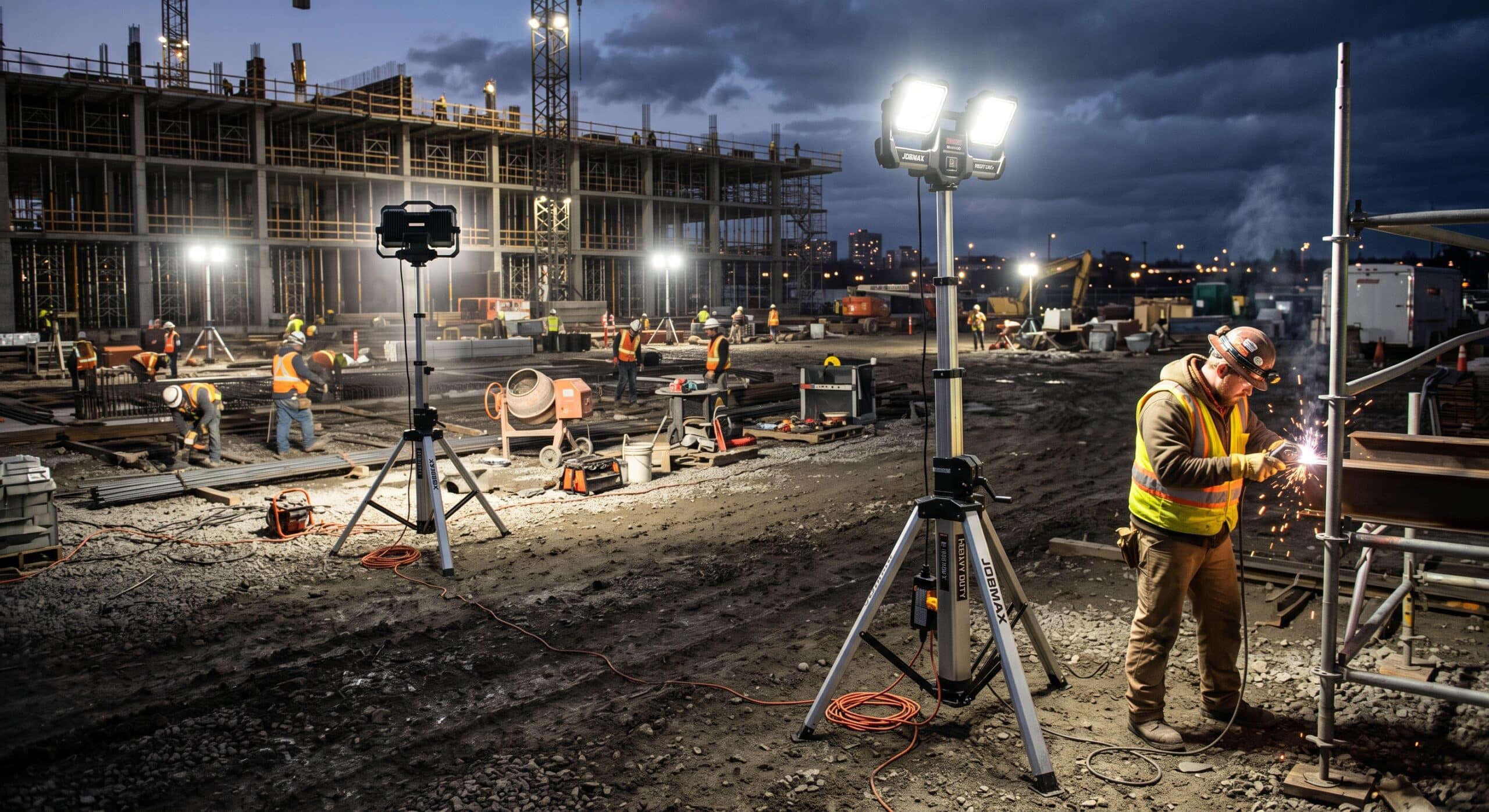
Best Tripod LED Work Lights for Large Job Sites
I have run enough job sites to lose count. If one piece of equipment gets fought over more than the good wheelbarrow, it is the tripod work light. Everybody wants it pointed at their section. Everybody complains when it is not bright enough. They complain when the battery dies at 3 p.m. in December, or when the wind knocks it into the mud during a Tuesday inspection.
So when someone on my crew asks what tripod work light to buy, I do not send them a spec sheet. I tell them what I have actually used. I tell them what breaks, and what keeps working after two years in the back of a truck.
This guide is written from that seat. I am not a lighting engineer and I do not sell tools. I am a site superintendent who keeps a crew productive and safe from before sunrise until after sunset. A tripod work light is one of the few pieces of gear that touches almost every trade on a large job. Framers need it for early morning layout. Electricians need it in a mechanical room with no windows. Once they’re inside a panel or wall cavity, though, a tripod stops being the right tool. That’s covered in our guide to the best work lights for electricians in tight spaces. Inspectors need it to see what they are signing off on. Get the lighting wrong and you slow everyone down. You also open yourself up to a safety citation you did not need.
Why a Tripod Work Light Matters More Than People Think
Lighting Becomes Part of the Schedule
On a small residential remodel, you can get away with a single clamp light and a headlamp. On a large commercial or multifamily job, lighting becomes part of the schedule. Framing crews start before sunrise for six months of the year. MEP rough in happens in windowless shafts and basements at any hour. Punch list walks in December happen with maybe seven hours of usable daylight. If lighting is an afterthought, you are going to eat delays. You will also see rework from mistakes nobody could actually see. Worse, someone could get hurt because they could not spot a trip hazard or an open floor penetration.
Why a Tripod Work Light Beats a Handheld or a Clamp Light
That is where a tripod work light earns its keep. A tripod gets the light source up off the ground, above head height. That spreads the beam across a wider area. It also cuts down on the harsh shadows a low light throws across scaffolding, rebar, and tool cords. It is adjustable on the fly, too. A carpenter can swing the head and raise the legs on uneven ground in under a minute, with no extra hands needed. Nobody’s arguing for going back to a corded halogen shop light either. We explain why LED won that fight in LED work light vs halogen. The short version: heat, weight, and bulb life all favor LED on a tripod.
The OSHA Compliance Angle
There is also a compliance angle superintendents cannot ignore. OSHA sets minimum illumination levels for construction under 29 CFR 1926.56, and the numbers are not generous. General construction areas, concrete placement, excavation, and active storage areas need 3 to 5 foot candles while work is in progress. General construction plants and shops need 10 foot candles. First aid stations and offices need 30. Those numbers read low next to what a bright LED tripod work light puts out. But OSHA treats lighting as a documented safety requirement, not a courtesy. When an inspector walks a dark stairwell or unlit mechanical room, that is a citation waiting to happen. It is a cheap one to avoid. For the full breakdown, see our guide to job site lighting requirements.
What to Look For in the Best Tripod Work Light
I have gone through more of these than I care to admit. Most of them fail in the same three or four ways. Here is what I check before I approve a purchase order.
Lumen Output for a Tripod Work Light
Lumens tell you total light output. The number alone does not tell you whether a light will work for your application. A small flood light at 400 to 1,000 lumens is fine for close detail work, like a punch list item or a small utility closet. For an open bay or a section of an active job site, you want 3,000 to 12,000 lumens. For whole area coverage on a large site, tower style lights climb toward 15,000 to 20,000 lumens. The most common mistake is a foreman buying a light rated for a garage. Then he tries to light a half acre pour with it. Match the tool to the area, not the price tag.
IP Rating, Because Job Sites Are Not Clean Rooms
An IP rating tells you how well a light is sealed against dust and water. Anything below IP54 does not belong on an active job site. I want IP65 at minimum for general use. I want IP67 if the light goes near a slab pour or an exterior job in the rain. The same goes for sites with pressure washing nearby. The DEWALT DCL079B, for example, carries an IP55 rating. That is fine for typical interior and covered exterior use. It is not the light I would leave sitting in standing water overnight. Milwaukee’s tower style lights go up to IP67, rated submersible to about a meter. That matters more than people expect once monsoon season hits.
Corded, Battery, or Hybrid Tripod Work Light
This decision comes down to how your site is set up. If you already have generator power and GFCI distribution on every level, go corded. It gives you unlimited runtime and usually brighter output for the price. If your crew is still roughing in electrical, go battery powered. We cover what separates a good option in our guide to the rechargeable work light for contractors. A light on the same platform as your drills and saws means one less thing to plan around. Many manufacturers now build hybrid units that run on battery and also plug into AC power. That is the option I push people toward these days. It covers both situations without buying two lights.
A few newer tower lights also add Bluetooth dimming and app control. We’ve put a handful of those smart LED work lights compared side by side. On a job site, though, I still weigh physical durability well above the app layer.
Color Temperature
Most job site lights land around 5000K, a clean, neutral white close to daylight. That is the number I tell crews to look for. It makes it easier to judge true colors on paint, drywall mud, and finish materials. It is also less fatiguing over a ten hour shift than a bluer 6500K light. A warmer 3000K light looks cozy in a showroom. It is the wrong choice for a job site, though. Someone still needs to spot a hairline crack in concrete or read a tape measure in January dusk.
Tripod Height, Stability, and Mounting Head
Look for a tripod that extends to at least six feet, ideally closer to seven. That clears scaffolding, stacked material, and people’s heads. Check how wide the legs spread and what the footprint looks like on uneven ground. A narrow base on soft dirt or gravel is a problem waiting to happen. It is how a $200 light ends up face down in the mud after the first gust. The head should rotate and tilt independently of the tripod, so your crew can aim it without moving the stand. A 360 degree swivel head is worth paying extra for on a large site.
Build Quality
A work light on a big project gets dropped, run over, and left out overnight. Someone will use it as a step stool at some point, whether you like it or not. Metal or reinforced polymer housings hold up far better than bargain plastic units that crack the first time they tip. Check whether replacement lenses, batteries, or bulbs are sold separately. A light you cannot repair is a light you throw away after one hard season.
The Tripod Work Light Setup I Run on a Large Site
I am not going to pretend there is one perfect light for every job, because there is not. What I do is keep a mix of three types on hand.
General Area Coverage
For a large open floor or a slab pour, I like a battery platform tower light in the 2,500 to 3,000 lumen range. It should match the cordless tool system the crew already runs, so batteries are interchangeable. Milwaukee’s M18 Rocket tower light is common on my sites for exactly that reason. The same batteries that run our saws and drills drop straight into the light. DEWALT’s 20V tripod work light kit is another one I see a lot on 20V MAX platforms. It runs around 3,000 lumens with a folding tripod one person can set up in under a minute. Once the building envelope is closed and the yard is permanent, a mounted industrial LED flood light takes over the long term exterior job.
Rough-In Work in Mechanical Rooms and Stairwells
For rough in inside mechanical rooms and stairwells, a smaller tower or stick light is usually plenty. Look for one in the 1,500 to 2,500 lumen range on the same battery platform. One trade can carry it around without a second person. For a lot of that work, a magnetic mount light clipped to a duct or stud does the job better than a full tripod anyway. HVAC crews setting equipment in those rooms often carry their own kit, which we cover in our guide to the LED work light for HVAC technicians.
Long Duration Exterior Use
For long duration exterior use, like a night pour or punch list work after daylight savings ends, I lean toward a corded or hybrid unit. It can run off generator power indefinitely. Nobody has to stop and swap batteries in the middle of a finish. On sites with no power run yet, a few subs have started using solar rechargeable work lights as a stopgap between visits. I still treat those as a backup rather than a primary light source.
Whatever brand you land on, buy at least two or three of the same model. That lets your crew standardize chargers, batteries, and mounting accessories. Mixing five brands across a site sounds flexible in theory. In practice, nobody can find a charger that fits when they need one.
Buying vs Renting a Tripod Work Light
On a job that runs six months or longer, I almost always buy. The lights pay for themselves in saved labor hours within the first few weeks. Owning the gear also means it is ready the moment you need it. Renting can make more sense for a short project. The same goes for a job where you may not need heavy lighting again for a year. Just check the rental unit before it leaves the counter. A scratched lens or a tripod leg that will not lock is not something you want to find at six in the morning. That is especially true an hour from the nearest rental return.
Setting Up a Tripod Work Light So It Actually Helps
Buying the right light is half the job. Where you put it matters just as much, and this is the part that gets skipped on busy sites.
Spread the Light Instead of Clustering It
Spread your lights out instead of clustering them in one spot. A single bright tower light in the center of a room creates a hot zone in the middle. It also leaves deep shadows along the walls, exactly where people trip on debris or step into an open trench. Two or three moderate lights around the perimeter give you more even coverage with fewer hard shadows. It is the same principle behind a good permanent warehouse work light layout.
Watch Your Angle and Your Cords
Angle the head down and slightly across the work area rather than straight at eye level. Glare from a light aimed at someone walking toward it is worse than no light at all. It is a common complaint I hear from subs working near the entrance of a lit area.
Keep cords and battery packs off the walking path. This sounds obvious, but on a fast moving site it is one of the most common near misses I write up. Run cords along a wall or overhead where possible. If a cord has to cross a path, use a cord cover. Or route it through a doorway threshold instead of leaving it flat across foot traffic.
Check Footing and Use GFCI Protection
Check your tripod footing every time you move it. Concrete slabs are forgiving. Gravel, mud, and uneven subgrade are not. A light that tips over mid shift is a hazard, and it is out of service until someone checks it for damage.
If you run lights outdoors or near water, always run them through a GFCI protected circuit. That can be a portable GFCI box, a temporary power spider box, or a generator’s built in GFCI outlet. This is not optional. It is one of the first things an OSHA inspector checks on a walk through. And around fuel storage, solvent cleanup, or spray finishing, a standard tripod light is the wrong tool entirely. That calls for a certified explosion proof work light.
Tripod Work Light Mistakes I See Constantly
Buying Cheap and Under Lighting the Space
The most common mistake is buying the cheapest option, then being surprised when the housing cracks after a month. A job site light takes abuse daily. But the internals, like the LED driver and battery contacts, should last several years. That only happens if you spend a reasonable amount up front.
The second mistake is under lighting large spaces. A foreman assumes one light will cover an area it clearly cannot. Walk the space at the time of day the work actually happens, not at noon. Check whether you can read a tape measure and spot a trip hazard from every corner.
Ignoring Battery Management and Seasonal Shifts
The third mistake is ignoring battery management on a big crew. If fifteen guys pull from the same batteries for tools and lights, someone ends up with a dead one. It usually happens at six in the morning. Dedicate a charging station to light batteries, separate from tool batteries. That way lighting is never what goes down because someone forgot to swap a pack. Our guide to LED work light battery life explains how to stretch those packs further.
The fourth mistake catches even experienced superintendents off guard. They forget lighting entirely when the schedule shifts into shorter winter days. A framing crew that started in July with full daylight can be starting and finishing in the dark by November. Build a seasonal check into your site walk routine. Add lighting before the complaints start, not after someone gets hurt on an unlit stair run. A motion sensor work light in stairwells and corridors helps cover those gaps without anyone remembering a switch.
Keeping Your Tripod Work Light Running
A tripod work light is cheap insurance against wasted labor hours, but only if it works when someone reaches for it. Wipe lenses down regularly, since dust and drywall mud cut output more than people realize. Store batteries at a reasonable temperature, not in a truck bed through a heat wave or a hard freeze. Extreme temperatures shorten battery life fast. Inspect tripod legs and locking mechanisms every few weeks. A leg that no longer locks is how a light ends up on the ground. Keep a couple of spare units on hand for a large crew. Losing your only good light on a Friday, with an inspection Monday, is not a position you want to be in.
Frequently Asked Questions About the Best Tripod Work Light for a Job Site
How many lumens do I need for a large job site?
For general area coverage on an open floor or exterior work area, look for a tripod work light in the 3,000 to 12,000 lumen range. Consider a tower style unit closer to 15,000 to 20,000 lumens for whole site coverage. Smaller detail or punch list work can get by with 1,000 to 2,000 lumens. Pro Tool Reviews breaks this down further by application in its Best LED Work Light Buying Guide.
What minimum lighting level does OSHA actually require?
Under 29 CFR 1926.56, general construction areas, excavation, and active storage areas need at least 3 to 5 foot candles while work is happening. General construction plants and shops need 10 foot candles. First aid stations and offices need 30. You can read the full standard at OSHA 1926.56 Illumination.
Are battery powered tripod lights bright enough for a whole crew, or do I need corded?
Battery platforms have closed most of the gap with corded lights in recent years. Several cordless tower lights now put out 2,500 to 3,000 lumens on a single charge. That is plenty for most rough in and general work. For all night pours or long exterior jobs where you cannot stop to swap batteries, a corded or hybrid unit is still the safer call.
What IP rating should a job site light have?
IP65 is a reasonable minimum for general job site use. IP67 is worth paying for near standing water, exterior slab work, or pressure washing. Anything under IP54 really only suits a clean, covered interior space.
Do tripod lights need to be on a GFCI circuit?
Yes. Any corded work light used outdoors or in a wet location needs GFCI protection. That can be a spider box, a portable GFCI unit, or a generator with a built in GFCI outlet. This is standard practice, and inspectors check for it directly.
How tall should the tripod extend?
Look for a tripod that reaches at least six feet, ideally closer to seven. That height clears scaffolding, stacked material, and foot traffic. A taller mounting height also spreads the beam wider and reduces harsh shadows.
References
- Occupational Safety and Health Administration. “1926.56, Illumination.”
- Pro Tool Reviews. “Best LED Work Light Buying Guide, Who Needs Halogen?“
- Pro Tool Reviews. “DeWalt 20V Tripod Light DCL079 Review.”
- ToolGuyd. “New Milwaukee M18 LED Tripod Worklight and Other New M12 and M18 LED Lighting Products.”
- Bob Vila. “The Best Work Lights for the Workshop or Jobsite, Tested.”
- DEWALT. “20V MAX Cordless Tripod Light (Light Only), DCL079B.”
- Milwaukee Tool. “Jobsite Flood, Tower and Handheld Lighting.”