
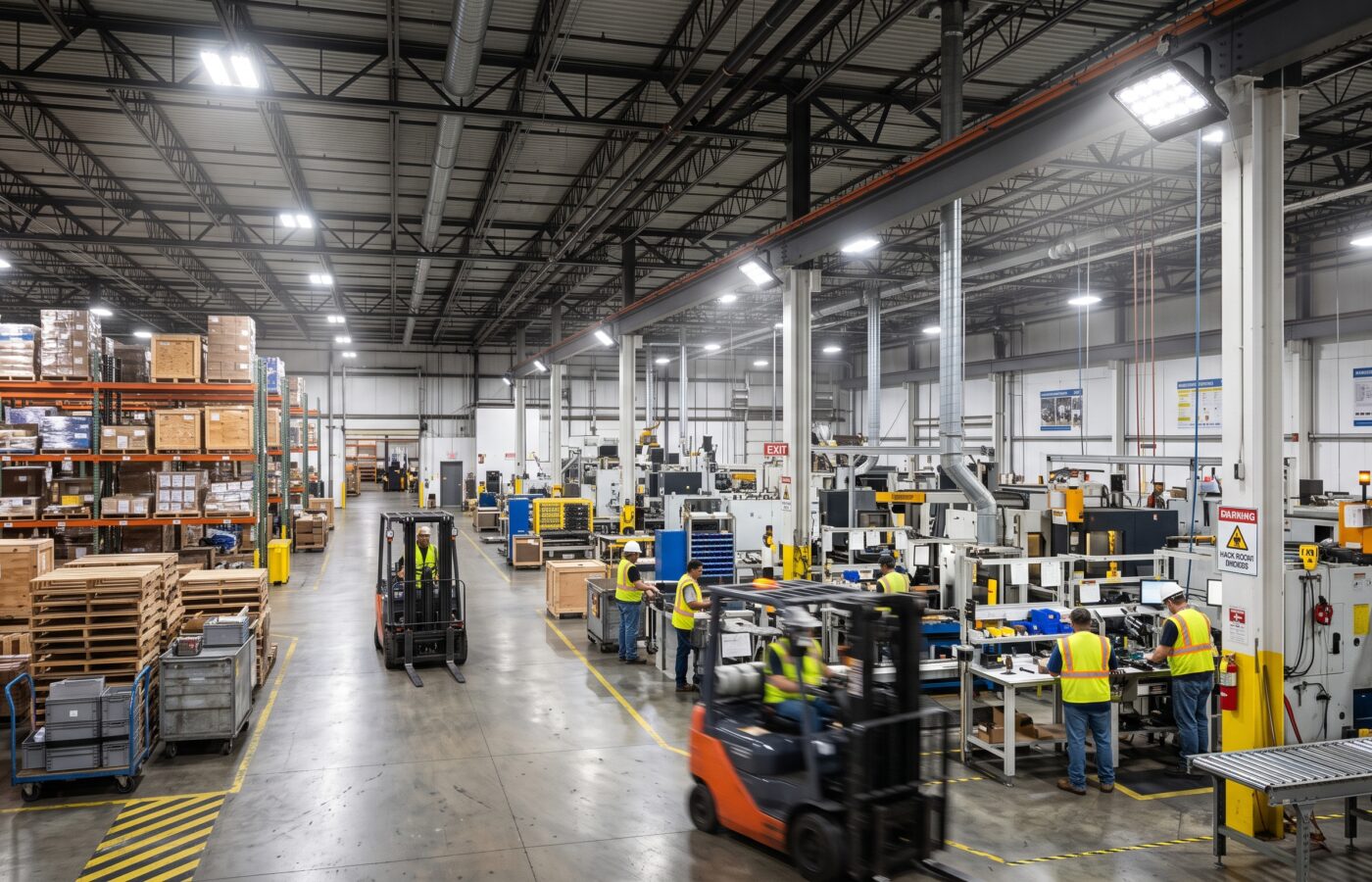
Industrial LED Flood Lights for Warehouses and Manufacturing Floors

The first plant I ever relit, long before the industrial LED flood light became the standard, had a ceiling full of 400 watt metal halide fixtures. Every time the utility flickered, the building went dark for twelve minutes while the lamps cooled and restruck, and as a result forty people stood around waiting. In addition, half the lamps had shifted toward a sickly green, a few were cycling on and off, and the maintenance lead kept a scissor lift parked in the corner because he was up there almost every week.
That was a long time ago. Since then, I have specified, aimed and commissioned lighting in distribution centers, stamping plants, cold storage buildings, food processing rooms and more loading docks than I can count. The fixture that comes up in nearly every one of those projects is the industrial LED flood light. However, it is also the fixture that gets bought wrong more often than any other, usually because someone shopped by wattage and price instead of by the job the light needs to do.
This article is the conversation I have with facility managers before they spend money. In other words, it is not a product roundup. Instead, it is how I think through the problem as an engineer, and how you can avoid paying twice.
What an Industrial LED Flood Light Actually Is
People use “flood light” loosely, so let me be precise. A flood light is a directional luminaire. It mounts on a yoke or trunnion bracket so you can tilt and aim it, and it throws a controlled beam toward a specific area. By contrast, a high bay hangs from the ceiling and pushes light straight down in a broad, symmetric pattern.
That difference matters. Specifically, an industrial LED flood light earns its place where you need to put light somewhere a downlight cannot reach well:
- Very tall ceilings where you want to aim from the structure toward a specific zone
- Loading docks, truck courts and staging yards
- Crane bays where the bridge crane blocks ceiling mounting
- Column or wall mounting along the edges of a production floor
- Rack faces that need vertical light, not just light on the floor
- Outdoor storage, scrap yards and perimeter security
When a facility buys flood lights to do the job of high bays, or high bays to do the job of flood lights, the result is the same. You get bright spots, dark spots, glare in operators’ eyes and complaints within a month. Therefore, choosing the right fixture type comes before choosing the right fixture.
Sizing an Industrial LED Flood Light: Start With the Task
The single most useful habit I can give you is this: define the light level you need at the work surface before you look at a single spec sheet.
What the Regulations Say
In general industry, the regulatory baseline is surprisingly vague. Construction and shipyard rules, including the job site lighting requirements most contractors know, list specific footcandle minimums, whereas general industry facilities are held to a broader standard of “adequate” illumination. Still, there is one hard number every warehouse should know. Under the powered industrial truck rule, 1910.178(h)(2), auxiliary lighting is required on forklifts when general illumination falls below about 2 footcandles. That said, this is a floor, not a target, and nobody should be designing to it.
What Engineers Actually Design To
For real design targets, engineers lean on the Illuminating Engineering Society. For example, typical guidance runs roughly 10 to 30 footcandles for basic material handling and rough warehousing, 30 to 50 for general assembly and machining, 50 to 100 for fine assembly and detailed inspection, and 100 or more for precision bench work and quality control.
Two Practical Notes From the Field
Design to maintained light, not initial light. Every fixture loses output over time, and dust on the lens takes even more. Consequently, if you design for exactly 30 footcandles on day one, you will be under it in a couple of years. For this reason, I typically build in a light loss factor somewhere around 0.8 to 0.85 for clean indoor spaces and lower for dusty or oily environments.
Measure where the work happens. For instance, a pick face at eye level in a narrow aisle needs vertical illumination on the rack. Similarly, a machining cell needs light on the part and the controls, not just on the floor. After all, a light meter laid on the concrete tells you very little about whether an operator can read a label on the top shelf.
Lumens and Efficacy: Judging an Industrial LED Flood Light
Old habits die hard. Even today, people ask me for “a 300 watt LED” because they are replacing 1000 watt metal halides. Watts tell you what the fixture draws from the panel. However, they tell you nothing about how much light lands on the floor. The same lesson applies when weighing an LED work light vs halogen on a smaller scale.
Delivered Lumens and Efficacy
First, look at delivered lumens. This is the total light output of the complete fixture, after the optics and lens. Accordingly, ignore “LED chip lumens” or “raw lumens” claims, since they describe the diodes before any losses.
Next, check efficacy in lumens per watt. This is essentially the efficiency score. A modern, well built industrial LED flood light should be comfortably above 130 lumens per watt, and the better ones climb well past 150. On the other hand, if a cheap unit is quoting 100, you are paying for it on every electric bill for the next decade.
Third Party Verification for an Industrial LED Flood Light
In North America, I put a lot of weight on the DesignLights Consortium listing. Its Qualified Products List gives utilities and efficiency programs guidance on which commercial solid state lighting products are efficient enough to qualify, and members use it to confidently offer rebates. In practice, that listing does two things for you. First, it confirms the photometric claims were tested by an approved lab. Second, it usually unlocks utility incentives that can knock a serious chunk off the project cost.
Rated Life, Read Properly
LED life is not a burnout date. Rather, LED lifetime is based on a prediction of when light output drops by 30 percent. That is the L70 figure. So a fixture rated L70 at 100,000 hours should still deliver 70 percent of its original light at that point. When comparing products, also check that the L70 claim is backed by LM80 test data on the diodes and a TM21 projection, not just a round number printed on a box.
Industrial LED Flood Light Beam Angle and Mounting Height
If I had to pick the one spec that ruins more flood light projects than any other, it would be beam angle.
Understanding Beam Spreads
A flood light’s beam is the cone of light it throws. Narrow beams, roughly 15 to 30 degrees, push light a long way and therefore suit very high mounting or long throws across a yard. Medium beams, around 40 to 60 degrees, are the workhorse for aimed lighting from columns and structure. Meanwhile, wide beams, 90 degrees and above, spread light over a large area from a lower mounting point.
The Two Classic Mistakes
The mistake I see constantly is a wide beam fixture mounted high. For example, a 120 degree flood bolted 45 feet up throws most of its light sideways onto walls, rack tops and roof deck, and very little onto the floor where people work. As a result, the facility adds more fixtures to compensate, and the energy savings they were promised quietly disappear.
The opposite mistake happens too. In that case, a narrow beam at 20 feet creates bright circles on the floor with dark gaps between them. Forklift drivers moving from a bright patch into a dark one lose their vision for a second, and unfortunately that is exactly when accidents happen.
My Industrial LED Flood Light Layout Process
On every project, I follow the same approach:
- First, get the IES photometric files from the manufacturer. Any serious maker has them.
- Then run a point by point layout in lighting software with real mounting heights, aiming angles and surface reflectances.
- After that, check uniformity, not just average. I want the ratio of maximum to minimum light under about 3 to 1 in working areas, and tighter than that in inspection zones.
- Finally, look at glare from the operator’s position. A flood aimed so that a forklift driver looks straight into it when backing out of a trailer is a safety problem, regardless of what the footcandle report says.
In addition, asymmetric optics are worth asking about. Many quality flood lights now offer forward throw distributions that push light out and down from a wall or column without blasting light back toward the mounting surface. On dock aprons and along production line edges, they are often the difference between a clean layout and a messy one.
Choosing Color Temperature and CRI for an Industrial LED Flood Light
Color temperature describes how warm or cool the light looks. For industrial spaces, the practical choices are 4000K and 5000K.
I lean toward 4000K for most general warehouse work because it reads as clean and neutral without the harsh, bluish feeling some people dislike over a long shift. However, for manufacturing floors where operators inspect finishes, read fine markings or match colors, 5000K often makes sense since it renders detail crisply.
Color rendering index, or CRI, gets less attention than it should. Most industrial fixtures ship at CRI 70 or 80. For bulk storage and loading, 70 is fine. In contrast, for assembly, paint, wiring harness work, food inspection or any task where telling one color from another matters, I specify CRI 80 at minimum and push for 90 in quality control areas. After all, a technician who cannot tell a brown wire from a red one under poor light is not dealing with a minor inconvenience.
Building an Industrial LED Flood Light for Heat, Dust and Vibration
A flood light in an office lobby lives an easy life. An industrial LED flood light, on the other hand, does not. Here is what I check before anything goes on a submittal.
Ingress Protection
The IP rating tells you how well the fixture keeps out dust and water. Generally, IP65 is my minimum for any industrial or outdoor location. IP66 is better for docks exposed to driving rain, and for washdown areas in food and beverage I look for IP66 or IP69K along with materials that tolerate caustic cleaners.
Impact Resistance
The IK rating covers physical hits. Therefore, anything mounted where a forklift mast, a swinging load or a thrown pallet could reach it should be IK08 or better, with IK10 preferred.
Heat
Heat is the quiet killer of LED fixtures. Indeed, thermal management is generally the single most important factor in how well an LED performs over its lifetime. Near furnaces, ovens, heat treat lines or under a hot steel roof in summer, ambient temperatures at fixture height can exceed 50°C. For that reason, always check the fixture’s rated ambient temperature. A unit rated for 40°C mounted at the roof peak of a foundry will fail early, and moreover the warranty fine print will almost always exclude it. The same heat punishes portable gear, which is why crews servicing rooftop units should carry an LED work light built for HVAC technicians.
Vibration
Fixtures mounted on crane runways, press structures or near heavy rotating equipment need vibration rated housings and secure brackets. To give one example, I have pulled flood lights down where the driver had literally shaken loose inside the housing. Electricians opening those housings at height will appreciate the best work lights for tight spaces.
Surge Protection
Industrial power is noisy. Motors starting, welders, VFDs and lightning on outdoor circuits all create spikes. Consequently, I want 10kV surge protection integrated into the fixture, and on yard lighting I often add separate surge protection at the panel as well.
Hazardous Locations
If flammable vapors, combustible dust or fibers are present, ordinary fixtures are off the table. Instead, you need lighting listed for the specific classification of that area, such as Class I Division 2 or Class II Division 1, and any portable lighting there should be an explosion proof work light. Simply put, this is not a place to save money or improvise.
Pairing an Industrial LED Flood Light With Smart Controls
Swapping metal halide for LED saves energy. Even so, adding smart controls is where the savings really stack up, and it is something old HID lighting could never do well because those lamps hated being switched and took minutes to warm up.
Control Strategies That Work
Because LEDs come on instantly at full output, they open the door to several strategies:
Occupancy sensing. Warehouse aisles sit empty most of the day. Thus, motion sensor controls that drop fixtures to 10 or 20 percent when nobody is present, then bring them to full the moment a forklift turns in, can cut aisle lighting energy dramatically.
Daylight harvesting. Similarly, buildings with skylights or clerestory windows can dim fixtures automatically when daylight is doing the work.
High end trim. Most projects end up slightly overlit because designers round up. Trimming maximum output to the level you actually need, therefore, saves energy and extends fixture life at the same time.
Scheduling. Likewise, yard and dock floods tied to photocells and time clocks avoid the classic sight of a fully lit yard at noon. For remote yard corners with no power run yet, a solar rechargeable work light can cover the gap temporarily.
Plan for Controls From Day One
Manufacturers who work in this space report big numbers. For example, Current states that longer lasting, efficient LED lighting can cut lighting energy use in an industrial facility by upwards of 50 percent. Furthermore, with good controls layered on top, I have seen projects go further than that.
For controls to work, however, specify every industrial LED flood light with 0 to 10V dimming drivers or networked controls from the start. Otherwise, retrofitting dimming later is expensive and sometimes impossible.
Warehouses and Manufacturing Floors Are Two Different Problems
I often see the same fixture specified throughout a building that contains both storage and production. Unfortunately, that rarely works well, because the visual tasks are completely different.
Industrial LED Flood Light Use in Warehouses
In warehouses, the challenge is vertical. Pickers read labels on rack faces from the floor to 30 feet or more, and drivers need to see the tines and the load at height. So flood lights aimed down aisles, or high bays with aisle optics, put light on the rack faces instead of the rack tops. Open bulk storage areas, by comparison, can use wider distributions. Docks also need strong, glare controlled light inside trailers, which is often handled by dedicated dock lights in addition to apron floods outside. For the full picture on fixed and portable options, see our guide to choosing a warehouse work light.
Industrial LED Flood Light Use on Manufacturing Floors
On manufacturing floors, the challenge is shadows and detail. Machinery, conveyors, robots and overhead structure all cast shadows, and light from a single direction makes them worse. For this reason, I prefer cross lighting, where fixtures aimed from multiple angles fill in each other’s shadows. Higher CRI and higher light levels then go to assembly and inspection, with lower levels in aisles and staging.
The Flicker Problem
There is one issue on production floors that many buyers never hear about: flicker. Some cheap LED drivers produce fast pulsing output that the eye does not consciously notice. Around rotating equipment such as lathes, saws and spindles, however, that pulsing can create a stroboscopic effect that makes moving parts appear slowed or stopped. Clearly, that is a genuine hazard. So ask for flicker data, and choose drivers with very low percent flicker. Reputable manufacturers will provide it.
Industrial LED Flood Light Retrofit Costs and Savings
Facility managers have to justify the spend, so let me walk through a simplified example of the math I run.
A Simple Energy Calculation
Say a building has 60 metal halide fixtures with 400 watt lamps. With ballast losses, each one draws roughly 458 watts. Now suppose we replace them with LED fixtures drawing 200 watts each, delivering equal or better light on the floor.
- Savings per fixture: 458 minus 200 equals 258 watts
- At 6,000 operating hours per year: about 1,548 kWh saved per fixture
- At $0.14 per kWh: roughly $217 per fixture per year
- Across 60 fixtures: around $13,000 per year in energy alone
Savings Beyond the Electric Bill
Notably, that figure does not include the controls savings described above. Nor does it include reduced lamp and ballast replacements, the lift rentals and labor that go with them, or the lower cooling load from fixtures that dump less heat into the building. On top of that, it leaves out the utility rebate, which for DLC listed products can cover a meaningful share of the fixture cost.
Of course, your numbers will differ with run hours and electricity rates, so run them for your own building. In my experience, though, two shift and three shift operations usually see payback well inside three years.
Industrial LED Flood Light Installation and Maintenance Tips
Here are a few things I insist on that rarely appear in a spec sheet:
Aim at night or with the lights off. Aiming flood lights in daylight is guesswork. Instead, do the final aiming in dark conditions with someone at floor level and a radio. A tripod work light at the base of the lift and a rechargeable work light in the basket keep the crew safe, as long as its battery life covers a full night of aiming.
Lock and mark the aim. Once a fixture is aimed, tighten the knuckle properly and mark the position with paint. Otherwise, vibration and well meaning maintenance staff will move it. A magnetic work light stuck to the bracket makes the marks easy to see.
Keep a few spares. Order a small percentage of extra fixtures from the same production batch. That way, matching color across a ceiling years later is much easier.
Clean the lenses. LEDs need little maintenance. Nevertheless, a layer of oil mist or dust can cost you 20 percent of your light, so a simple cleaning schedule in dirty environments pays for itself.
Verify after commissioning. Take light meter readings at the same grid points the design used, and keep them on file. Then, if anyone ever asks whether the space was adequately lit, you will have the answer in writing.
Mistakes I See Over and Over
To close the technical part, here are the errors that send facilities back to me for a second project:
- Buying on wattage instead of delivered lumens and efficacy
- Using wide beam floods at high mounting heights
- Ignoring rated ambient temperature in hot buildings
- Choosing CRI 70 for inspection and assembly work
- Skipping dimming drivers, then wanting controls later
- Not asking for flicker data near rotating machinery
- Buying unlisted fixtures and missing out on rebates
- Never running a photometric layout before ordering
Fortunately, every one of these is avoidable with a little planning.
Final Thoughts
A well chosen industrial LED flood light is one of the most reliable upgrades a plant or warehouse can make. Not only does it lower energy bills, but it also all but eliminates the lift and ladder routine of relamping. Most importantly, it gives people the light they need to work safely. Even so, the fixture is only half of it. The other half is matching beam, mounting height, color, protection rating and controls to the actual tasks in your building.
In short, if you take one thing from this article, let it be this: start with the work being done under the light, and then choose the fixture. Do it in that order, and your lighting will still be doing its job long after the purchase price has paid for itself.
Frequently Asked Questions
What is the difference between an industrial LED flood light and a high bay light?
A flood light is aimed and directional, mounted on a yoke so it can be tilted toward a specific area. In contrast, a high bay hangs from the ceiling and lights straight down in a broad pattern. As a result, floods suit docks, yards, crane bays and column mounting, while high bays suit general overhead lighting. See the DesignLights Consortium for listed products in both categories.
How many footcandles does a warehouse need?
OSHA requires adequate illumination in general industry, and its forklift rule triggers auxiliary lighting below about 2 footcandles. However, practical design targets from IES guidance usually run 10 to 30 footcandles for warehousing and higher for assembly. For more detail, read the OSHA powered industrial truck standard and this overview of OSHA lighting standards.
What IP rating should an industrial LED flood light have?
IP65 is a sensible minimum for industrial and outdoor use. Beyond that, choose IP66 for exposed docks and IP66 or IP69K for washdown areas. The 1000Bulbs guide to OSHA lighting requirements also covers fixture protection requirements.
How long does an industrial LED flood light last?
LED life is rated by when light output falls to 70 percent of the original, known as L70. Typically, quality industrial fixtures list 50,000 to 100,000 hours or more. ENERGY STAR explains how LED lifetime is defined.
Should I choose 4000K or 5000K?
4000K works well for general warehousing and long shifts, whereas 5000K suits inspection and detailed manufacturing tasks. In either case, pair it with a CRI of 80 or higher where color matters. The Current industrial lighting page shows typical industrial options.
Can I get rebates for upgrading to LED flood lights?
Often, yes. Many utilities require products listed on the DesignLights Consortium Qualified Products List. Therefore, check the DLC website and your local utility’s commercial efficiency program.
References
- OSHA. Standard 1910.178, Powered Industrial Trucks
- OSHA. Standard 1926.56, Illumination
- ENERGY STAR. Learn About LED Lighting
- DesignLights Consortium. Qualified Products List and Resources
- Illuminating Engineering Society. IES Standards and Recommended Practices
- U.S. Department of Energy. LED Lighting
- SafetyIQ. OSHA Lighting Standards and Requirements Every Facility Manager Should Know
- 1000Bulbs. OSHA’s Lighting Requirements and You
- Access Fixtures. OSHA Lighting Standards: Compliance Guide for Workplace Safety
- Current. LED Industrial Lighting and Controls
- TÜV SÜD. DesignLights Consortium Qualified Products List