Heavy-Duty Work Lights Built for 24/7 Warehouse Operations

At 2:40 in the morning, a warehouse work light tells you everything about how a distribution center was designed. By then, the day shift has gone home. Meanwhile, the dock doors are open to a wet parking lot. Forklifts are pulling double pallets out of 30 foot racking, and the only thing between a picker and a mislabeled carton is the fixture overhead. I have walked hundreds of facilities at that hour, meter in hand. Usually, within ten minutes, I can tell whether the lighting was designed for the building or simply bought for it.
That difference matters more in a 24/7 operation than anywhere else. For example, a fixture in an office runs maybe 2,500 hours a year. In contrast, a warehouse work light in a three shift fulfillment center can burn close to 8,760 hours a year. On top of that, it sits in dust, heat and vibration, with the occasional bump from a reach truck mast. As a result, every weakness in the product shows up early. Likewise, every shortcut in the design shows up on the injury log or the maintenance budget.
This piece is how I approach the problem as an engineer who designs and troubleshoots warehouse lighting for a living. In other words, it is not a product roundup. Instead, it is the thinking I wish more facility managers had before buying a warehouse work light for a building that never stops.
Why 24/7 Operation Changes the Rules for a Warehouse Work Light
Most lighting specifications hide one assumption: the light gets a rest. Normally, drivers cool down overnight. Similarly, LEDs get a break from thermal stress. Maintenance crews also have quiet hours to swap failed units. In a 24/7 warehouse, however, none of that is true.
Continuous operation does three things. First, it compresses the calendar life of every component. A fixture rated for 50,000 hours sounds like it will outlast the lease. At nearly 8,800 hours a year, though, you get under six years of rated life.
Second, it raises the average operating temperature of the fixture. After all, heat never gets a chance to dissipate overnight.
Third, it makes every failure expensive. For instance, replacing a high bay at 35 feet means a scissor lift or boom in an active aisle. Consequently, that blocks traffic, reroutes pickers and sometimes stops a conveyor zone. In short, downtime is the real cost of a cheap fixture.
So when I evaluate a heavy duty warehouse work light, I am not asking how bright it is on day one. Instead, I want to know how bright it will be in year four. I also want to know how hot its driver runs in August under the roof deck. Finally, I want to know how often a lift truck will need to go up and touch it.
What a Warehouse Work Light Actually Has to Do
People use the phrase “work light” loosely, so let me separate the two jobs.
The first job is general illumination. These are the high bay and low bay fixtures mounted to the structure. Specifically, they light the aisles, staging areas, packing stations and docks. Because they are permanent and hardwired, they must be designed as a system.
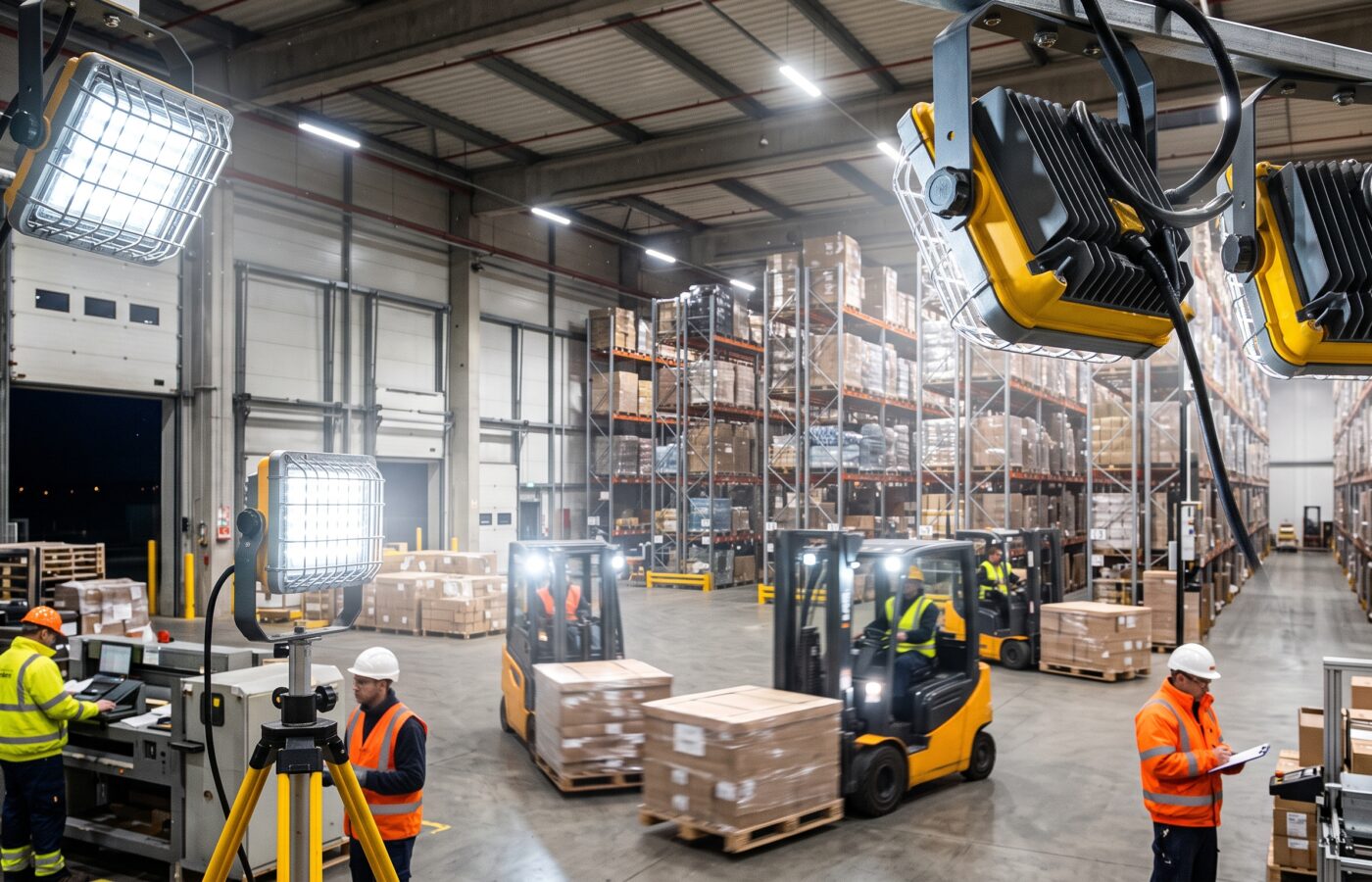
The second job, by contrast, is task and temporary lighting. This covers portable LED work lights, tripod units, magnetic base lights and dock lights that swing into trailers. In addition, it includes the rechargeable units maintenance techs carry into dark corners, much like the compact lights electricians rely on in tight spaces. These fill gaps the overhead system cannot reach, such as the inside of a 53 foot trailer or the back of a conveyor motor.
Therefore, a good plan treats every warehouse work light, fixed or portable, as part of the same design. For example, I have seen beautifully lit aisles paired with docks so dark that loaders worked by phone flashlight. The overhead system passed every calculation. Even so, the operation still had a visibility problem exactly where product changes hands.
Warehouse Work Light Levels I Actually Design To
This is where a lot of confusion lives, so let me be precise.
What OSHA Actually Requires
OSHA’s general industry standards do not set a single foot candle number for most warehouse spaces. In fact, the general industry rules mostly avoid minimum light levels for work areas, but OSHA can still cite an employer when poor lighting puts workers at risk.
Instead, the explicit numbers people quote come from the construction standard that governs job site lighting requirements. Under 29 CFR 1926.56, indoor warehouses, corridors, hallways and exitways must have at least 5 foot candles. Meanwhile, areas not covered by that table are pointed toward the ANSI practice for industrial lighting. Notably, OSHA proposed in July 2025 to rescind its construction illumination standard, arguing the General Duty Clause covers the hazard better.
Why Every Warehouse Work Light Plan Should Beat the Legal Floor
However, five foot candles is a legal floor, not a design target. Nobody can reliably read a lot number on a shrink wrapped pallet at that level. That is why designers lean on Illuminating Engineering Society guidance. Typically, recommendations run about 10 to 30 foot candles for rough warehousing, 30 to 50 for general assembly, and 50 to 100 for fine assembly and detailed inspection.
In practice, my targets for a busy fulfillment building look like this:
- Bulk storage and low activity aisles: 15 to 20 foot candles maintained
- Active pick aisles and forklift lanes: 25 to 35 foot candles
- Packing, labeling and shipping stations: 40 to 50 foot candles
- Quality control and returns inspection: 75 foot candles or more at the bench
Above all, notice the word “maintained.” Initial light levels are a sales number. Maintained levels, on the other hand, are what workers see after dust, lumen depreciation and lens yellowing do their work.
The Lumen Math Behind Every Layout
The basic arithmetic is simple. First, multiply the target foot candles by the floor area to get total lumens, so 50 foot candles across 1,000 square feet needs 50,000 lumens. Then divide by the output of each warehouse work light and a light loss factor. That last step, however, is where real engineering starts.
Electricians have long noted that lumen loss in service can cut usable output by 20 to 40 percent, depending on the lamp and fixture. Admittedly, modern LEDs lose far less than halogen and other legacy lamps. Still, I never design to initial lumens. Instead, I usually apply a combined light loss factor of 0.75 to 0.85. Naturally, the dirtier the building, the lower I go.
Warehouse Work Light Placement, Mounting Height and the Aisle Problem
Ceiling height drives fixture selection more than any other variable. For example, a 15 foot ceiling might be well served by fixtures in the 15,000 to 20,000 lumen range, while a 35 foot ceiling can call for 35,000 lumens or more. That is a good starting rule. Racking, however, changes everything.
Why Racking Turns Aisles Into Canyons
An open floor and a racked floor with the same ceiling are two different lighting problems. Once you install 28 foot selective racking with 10 foot aisles, you have built a canyon. As a result, a wide beam UFO high bay over the rack tops throws most of its light onto the top pallets. Meanwhile, the lower beam levels and the pick face fall into shadow.
The meter reading in the middle of the aisle floor might look fine. Yet the vertical light on the product labels is what the picker actually needs, and that is often poor.
Choosing the Right Warehouse Work Light Shape
For narrow aisles, therefore, I specify linear fixtures with aisle optics. They run down the length of the aisle, centered over it. Because the beam is narrow across the aisle and long along it, it pushes light onto the vertical rack faces. In some retrofits, switching to linear aisle optics raised label level readings by more than half. Better yet, we did not add a single fixture.
Similarly, lighting guides note that choosing between linear and UFO high bays depends on the warehouse layout and the lighting goals. My shorthand is simple. Use round fixtures for open floors, docks and staging. Otherwise, use linear fixtures for racked aisles and anywhere you need to steer the light.
Heat Is the Silent Killer of a Warehouse Work Light
If I could teach every facility manager one thing, it would be this. LEDs do not fail from age. Rather, they fail from heat.
The diode and especially the driver electronics degrade faster with every degree. Moreover, in a continuously running building, air at 35 feet can sit 15 to 20 degrees Fahrenheit hotter than the floor. So if you put a thin steel fixture there with a driver packed against the LED board, early failures follow.
What I Check on Every Fixture
When I review a fixture, I look first at the housing material and the thermal path. In general, aluminum is preferred over steel for heat dissipation, and a well built high bay is vented with a heat sink that pulls heat from both the diodes and drivers.
I also ask for the rated ambient temperature. For instance, a fixture rated to 40 degrees Celsius may be fine on paper but marginal in a hot unconditioned building. For those sites, I look for ratings of 50 to 55 degrees Celsius. Alternatively, I specify remote mounted drivers so the electronics live somewhere cooler.
Cold Storage Has Its Own Failure Mode
Cold storage, by contrast, is the opposite problem. LEDs actually perform well in the cold. Instead, condensation when doors open and brittle plastic lenses at freezer temperatures are what kill fixtures there. Either way, the lesson is the same: match the warehouse work light to the thermal reality of the space, not the brochure.
IP and IK Ratings Every Warehouse Work Light Needs
Dust and impact are the next two enemies. Fortunately, the industry has numbers for both.
Dust and Water Protection
IP ratings describe how well a product keeps out dust and water, while IK ratings describe impact resistance. Specifically, the first IP digit covers dust, and 6 means fully dust tight. The second digit, meanwhile, covers water.
For general dry warehouses, I want IP65 minimum on high bays. That way, it keeps out fine dust from cardboard, flour, feed and textiles. After all, dust inside a fixture is insulation sitting right on the parts you need to cool.
Washdown zones, however, need more. IP65 handles low pressure hose cleaning, while IP66 holds up against powerful high pressure washdown jets. Consequently, food distribution and cold chain docks often belong in that second group.
Impact Protection Near Forklifts
Impact rating is the one most buyers skip. Ironically, it also matters most near forklifts. An IK10 diffuser can take a 20 joule impact, whereas an unrated fixture hit by a pallet jack can leave bare LEDs exposed and create an electrical hazard. For reference, IK08 equals roughly a 1.7 kilogram mass dropped from 300 millimeters.
Therefore, for any warehouse work light over dock doors or within reach of a mast, I specify IK08 at minimum. Where traffic is heavy, I go to IK10.
Lumen Maintenance: Reading Between the Spec Sheet Lines
Every LED datasheet shows a big hour number. Before trusting it, though, you need to know what it means.
The common metric is L70. In other words, that is the point where the fixture produces 70 percent of its initial output. Some makers publish L80 or L90, and a few even offer constant output designs. For example, LEDVANCE has marketed a constant lumen high bay that holds the same brightness through an L100 life of up to 50,000 hours. Likewise, another manufacturer rates its warehouse high bays at 100,000 hours of continuous operation.
Nevertheless, treat any hour rating with healthy skepticism. Ideally, it should be backed by LM80 data for the LEDs and a TM21 projection. In addition, it needs in situ temperature testing of the full fixture. After all, a diode tested in a cool lab tells you little about life in a sealed housing at 35 feet in July.
Also, remember the driver. The LED board might reach L70 at 100,000 hours. If the driver is rated for only 50,000 hours, however, the fixture’s real life is the driver’s life. That is why I ask vendors for the driver brand, rated case temperature and warranty terms in writing.
Color Temperature and CRI for People Reading Labels at 3 AM
For warehouse work, I typically specify 4000K to 5000K. Generally, cooler white light helps contrast and alertness. This matters especially on the overnight shift, when people are fighting their own body clock. On the other hand, I avoid going much above 5000K in general areas. It can feel harsh on long shifts, and workers notice.
Color rendering, meanwhile, is underrated. A CRI of 80 is the practical minimum. However, some operations sort by color coded labels, inspect returns or handle tinted pharmaceutical packaging. For those stations, I push for CRI 90. Ultimately, better color rendering at the bench costs less than mispicks.
Glare, Uniformity and the Forklift Driver’s View
A foot candle meter will never tell you what the driver sees when he tilts his head back to place a pallet up top.
For example, a bare high output LED in his line of sight is blinding. Immediately, his pupils constrict. Then, for the next second or two, the rack below looks darker than it should. Multiply that by hundreds of lifts a shift, and you have a real safety issue. Worse still, it never shows up in a calculation.
How I Control Warehouse Work Light Glare
I control glare three ways. First, I specify frosted or prismatic lenses wherever a fixture sits in a driver’s sightline. Indeed, one linear high bay maker recommends lens diffusers below 15 feet and for mounting heights from 15 to 30 feet.
Second, I keep uniformity tight. In particular, I aim for a maximum to minimum ratio no worse than about 3 to 1 in working aisles. That way, eyes are not constantly adapting.
Third, I watch the transitions. The worst are a bright dock beside a dark trailer, or a lit aisle next to a dim cross aisle. Because eyes need time to adjust between light levels, lighting should be evenly spread without excessively bright or dark zones.
Smart Controls for a Warehouse Work Light That Never Sleeps
People assume controls make no sense in a 24/7 building. After all, everything is always on, right? Not quite. Even round the clock operations have aisles that sit idle for long stretches. For instance, reserve storage and seasonal overflow might get touched only a few times a shift.
For that reason, occupancy sensors with bilevel dimming are my default. Each warehouse work light drops to 10 to 20 percent when an aisle is empty. Then it ramps to full the moment a forklift turns in. As a result, workers never walk into darkness, and the building stops paying to light empty aisles.
LEDs make this practical because they handle constant switching well. Unlike metal halide and mercury vapor lamps, LED high bays dim and switch on instantly, which opens up savings from daylight and occupancy control.
In addition, daylight harvesting near skylights and dock doors adds more savings. Networked, smart LED controls also give you something underrated: fault reporting. With 1,200 fixtures, for example, knowing which unit failed before anyone complains is worth the investment.
Portable Warehouse Work Lights for Docks, Trailers and Maintenance Bays
Now, back to the second job. The overhead system cannot light the inside of a trailer. Nor can it help a technician working on a conveyor drive under a mezzanine or servicing rooftop units, where an LED work light built for HVAC technicians earns its keep.
For docks, I specify articulating LED dock lights beside each door. Ideally, they have a sturdy steel arm and a guarded head. They also need enough output to reach the nose of a 53 foot trailer. Outside, an industrial LED flood light over the yard apron keeps the approach to each door visible.
For maintenance teams, similarly, I recommend a rechargeable portable warehouse work light. Look for IP54 or better, an IK rating for drops and magnetic or hook mounting. Above all, pick a battery platform that matches the tools the team already owns. That way, shared batteries mean the work lights actually get charged.
For outages, likewise, keep a few portable tripod lights in stock. A solar rechargeable work light or two kept near a dock window is cheap insurance as well. When part of the building loses power mid shift, emergency egress lighting alone is not enough in racking aisles. Finally, keep emergency lighting in the same conversation. OSHA requires reliable illumination during power failures so workers can find exits.
Certifications, Testing and Rebates
In North America, the DesignLights Consortium Qualified Products List is my first filter. Specifically, high bays on the DLC list must meet performance and output requirements verified through LM79, LM80 and in situ case temperature reports from a third party lab.
Furthermore, that listing tends to unlock money. DLC listed fixtures may qualify for state and utility rebates that improve retrofit savings. Beyond that, I want UL or ETL listing for the application. For hazardous locations like grain dust or flammable storage, of course, the proper hazardous location rating is mandatory, and that includes using an explosion proof work light for any portable task lighting in those zones.
Overall, retrofit economics in 24/7 buildings are usually strong because burn hours are so high. For example, Dialight reported a US distribution warehouse pilot where 800 LED high bays matched more than 1,000 T5 fluorescents, with an expected payback of 14 months. Admittedly, your numbers will differ. Still, continuous operation is exactly where LED payback is fastest.
My Spec Checklist for a 24/7 Warehouse Work Light
When I write a warehouse work light specification for a round the clock facility, these lines are not negotiable:
- Maintained foot candle targets by zone, with a realistic light loss factor
- Optics matched to the space: aisle beams for racks, wide beams for open floor
- Aluminum housing with an ambient rating that fits the hottest point in the building
- IP65 minimum, IP66 in washdown areas
- IK08 minimum, IK10 near forklift traffic and docks
- Published L70 or better, backed by LM80 data and TM21 projections
- Driver brand, rated case temperature and surge protection listed
- 4000K to 5000K, CRI 80 minimum, CRI 90 at inspection stations
- Diffused optics wherever a driver looks up
- Bilevel occupancy control and fault reporting
- DLC listing and the right safety listing for the location
- A warranty of at least five years that covers labor or lift costs
The Bottom Line on Choosing a Warehouse Work Light
In the end, the best warehouse work light is the one nobody talks about. Pickers do not complain about it. Likewise, drivers do not squint at it. In fact, the maintenance supervisor forgets where the lift keys are because he rarely needs them.
Getting there, however, takes more than buying the brightest fixture on the shelf. Instead, you have to understand how your building runs at 3 in the morning, in August, with the dock doors open.
So if you are planning a retrofit, start with a real light level survey at night, with the operation running. Next, measure the vertical surfaces in your pick aisles, not just the floor. Then design to maintained levels, buy for heat and impact, and control what you can. After all, a building that never sleeps deserves a warehouse work light engineered for it.
Frequently Asked Questions About Warehouse Work Lights
How many foot candles does a warehouse need?
It depends on the task. Generally, rough storage targets 10 to 30 foot candles, packing and assembly 30 to 50, and detailed inspection 50 to 100. For more detail, see the SafetyIQ guide to OSHA lighting standards.
Does OSHA set a minimum light level for warehouses?
The 5 foot candle figure for indoor warehouses comes from the construction standard, 29 CFR 1926.56. However, general industry rules require adequate lighting without one fixed number. Read the J. J. Keller explainer on OSHA illumination.
What IP rating should a warehouse work light have?
IP65 is a sound minimum for dusty dry warehouses. Where high pressure washdowns happen, however, choose IP66. The LEDCO vapor tight fixture guide explains the difference.
What does an IK rating mean, and do I need one?
IK measures impact resistance on a scale up to IK10. Therefore, near forklifts and docks, IK08 or higher protects against exposed LEDs. See GlowLab’s overview of IP and IK ratings.
Should I use UFO or linear high bays?
Round UFO fixtures suit open floors and staging. In racked aisles, by contrast, linear fixtures with aisle optics usually work better. Compare both in PacLights’ high bay selection guide.
How many high bay lights does my warehouse need?
First, multiply target foot candles by floor area. Then divide by fixture lumens and a light loss factor. Commercial LED Lights walks through spacing examples.
Are occupancy sensors worth it in a 24/7 warehouse?
Yes. Many aisles sit empty for long stretches, and LEDs dim and switch instantly without damage. For an example, see LED professional on DALI controlled high bays.
References
- 29 CFR 1926.56 Illumination, OSHA
- O Say, How Well Can You See?, J. J. Keller and Associates
- OSHA’s Lighting Requirements and You, 1000Bulbs Blog
- OSHA Lighting Standards and Requirements Every Facility Manager Should Know, SafetyIQ
- How to Calculate Foot Candles for Industrial Lighting, PacLights
- How to Choose Warehouse LED High Bay Lights, PacLights
- How Many High Bay Lights Do I Need for My Warehouse?, Commercial LED Lights
- Foot Candles Discussion, ECN Electrical Forum
- 2 Foot LED High Bays, 1st Source Lighting
- Vapor Tight LED Fixture IP65 IP66, LEDCO
- What’s in a Rating? A Look at IP and IK, GlowLab
- Stream C Industrial Fixture Product Sheet, Norlux
- Controllable DALI High Bay Luminaires Provide Energy Savings, Electronic Specifier
- Ledvance DALI High Bay Luminaires Provide Further Energy Savings, LED professional
- Dialight DuroSite LED High Bay Fixture Certified by DesignLights Consortium, LEDs Magazine