
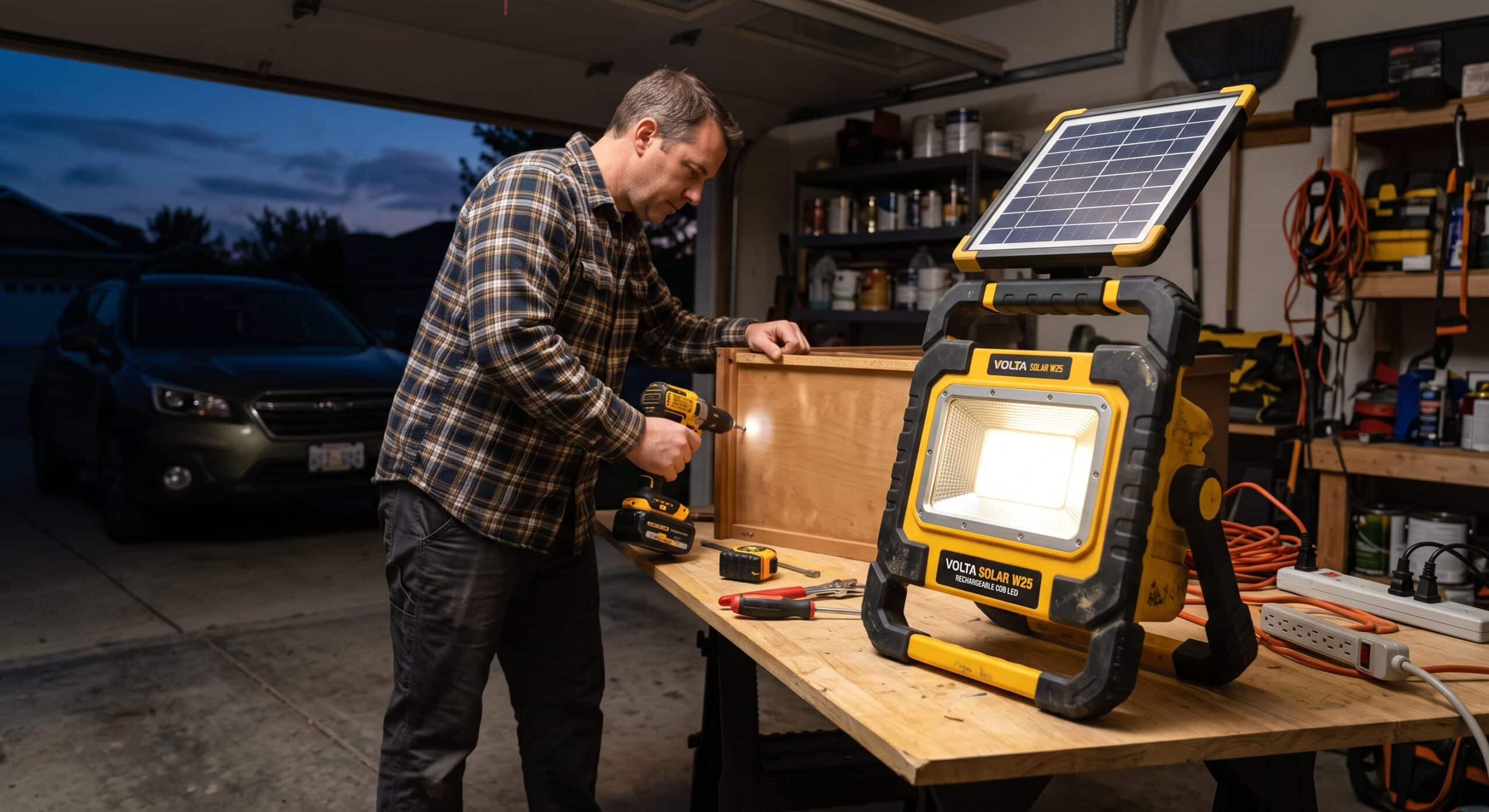
I get asked some version of this question at least once a month. Usually, it’s a neighbor standing in my driveway, pointing at whatever I’ve got clipped to my ladder: Is a solar rechargeable work light actually worth adding to your toolbox, or is that built-in solar panel just a marketing gimmick?
Fair question. If you have ever stared at a dead flashlight during a blackout or dragged an extension cord across a wet driveway, it’s a tool that makes a lot of sense on paper. I’ve torn apart enough of these units and burned through enough dead batteries in cold garages to give you a real answer—and it’s a bit more nuanced than a simple yes or no.
At its core, a solar rechargeable work light is a portable LED light with an internal battery pack that can be topped off using a wall outlet or a small photovoltaic panel built right into the housing. For homeowners, DIYers, and anyone preparing for storm season, they’ve become a surprisingly practical addition to the shelf.
The trouble is that “solar” gets thrown around pretty loosely in this market. A lot of what you see on store shelves is closer to a standard battery light with a decorative panel slapped on top than a genuine off-grid charging solution. To figure out if one is actually worth your money, let’s look at what’s really going on inside these tools.
What a Solar Rechargeable Work Light Actually Is
Strip away the marketing copy and any solar rechargeable work light comes down to four core components: an LED array, a rechargeable battery pack, a small monocrystalline or polycrystalline solar panel, and a charge controller managing current flow between them. Many models also feature a USB input for charging via a wall adapter or power bank when sunlight is limited. Every reliable unit should include this dual-charging option, as a small built-in panel rarely produces enough consistent wattage to serve as a standalone power source.
The distinction between a utility light and decorative solar fixtures is significant. Built for active task lighting, a heavy-duty solar rechargeable work light typically delivers between 500 and 10,000 lumens alongside a rugged housing rated for impact and moisture resistance. Practical additions like integrated tripod stands, hanging hooks, or magnetic bases enable hands-free placement in workshops and job sites. Ultimately, the solar panel functions as an auxiliary charging feature layered onto a high-performance battery system, rather than the primary driver of the tool.
How the Charging System Actually Works
This is the part most buying guides skip. It’s also the part that determines whether you’ll actually be happy with the purchase.
The Solar Panel and Realistic Charge Times
The solar panel generates direct current when exposed to light. How much it generates depends on panel size, cell efficiency, and how directly sunlight hits it. A palm sized panel rated at 1 to 3 watts is what you’ll find on most consumer work lights. That size panel can take 8 to 20 hours of direct, unobstructed sunlight to fully charge a battery from empty. That’s not a flaw in the product. It’s just the physics of a small panel. Cloud cover, shade, a dirty panel, or an indirect angle all cut into that number further, sometimes by half or more. If someone tells you their solar work light charges fully in a couple hours from a garage window, be skeptical. Either they’re exaggerating, or the battery is coasting on a previous charge.
Battery Chemistry Matters Just as Much
Most budget and midrange solar work lights use lithium ion cells, similar to what’s in a laptop or power tool battery. These offer good energy density and decent cycle life, typically 300 to 500 full charge cycles before capacity starts noticeably dropping. A smaller but growing number of higher end models use lithium iron phosphate cells, often labeled LiFePO4. These cost more up front. But they tolerate heat better and handle far more charge cycles, often 2,000 or more. They’re also less prone to the thermal degradation that shortens lithium ion life in a hot garage or truck bed. If you plan to use a light hard, daily, for years, that chemistry difference is worth paying for.
The Unglamorous Charge Controller
The charge controller does the real work behind the scenes. It regulates voltage coming in from the panel or USB port so the battery charges safely. It also prevents overcharging once the cell hits full capacity. Cheap lights sometimes skimp here, and it shows up as batteries that degrade fast or, in rare but real cases, swell or fail outright. When I evaluate one of these tools, charge controller quality matters more to my recommendation than the advertised lumen count.
Is It Worth It for Home Use? My Honest Answer
Yes, with real conditions attached. Let me walk through why rather than just hand you a verdict.
Why It Works for Most Homeowners
For general home use, meaning garage work, attic jobs, car repairs, camping trips, and outage prep, a solar rechargeable work light earns its keep. The value isn’t that the panel replaces a charging cable day to day. It’s that the panel gives you a backup charging path when the power is out, or when the light has been sitting in a shed for months. You grab it in an emergency and find the battery still has a usable charge, because it’s been slowly topping off near a window. That resilience is the actual selling point, and it’s a legitimate one.
I keep one of these in my own garage specifically for storm season. Where I live, outages happen a handful of times a year. They usually hit during weather bad enough that I don’t want to run an extension cord from a generator just to see what I’m doing. A fully charged solar work light with a few thousand lumens covers that need completely. Because it tops off passively near a window between uses, I’m not the guy discovering a dead battery in the middle of a blackout. If you’ve ever been that guy, you know it’s a miserable feeling.
Where Contractors Should Think Twice
For contractors or serious DIYers doing regular job site work, the calculus shifts slightly. If you’re on a site with reliable power and you’re charging tools every night anyway, the solar panel becomes a nice bonus rather than a core reason to buy. You’ll still get a capable work light. But you’re paying a premium for solar capability you might rarely lean on. In that case, weigh battery capacity and lumen output more heavily than the solar spec sheet.
Where Solar Rechargeable Work Lights Fall Short
I don’t like reviews that only tell you the good news. Here’s where I’d push back on the marketing.
The solar charging speed is almost always overstated in product listings. Manufacturers test under ideal lab conditions with direct, perpendicular sunlight. Almost nobody experiences that in a driveway or job site. Expect real world charging to take noticeably longer than the box claims. If you’re depending on solar as your primary charging method rather than a backup, you’ll likely be disappointed.
Cold weather is another real limitation. Lithium ion batteries lose capacity and charge more slowly in cold temperatures. A light sitting in an unheated garage through a winter night may run shorter than it did in summer, even at a full charge. This isn’t unique to solar work lights. It’s true of lithium batteries generally. Still, it’s worth knowing if you’re relying on one for winter emergency use.
Build quality varies enormously across price points. I’ve opened up budget models where the solar wiring was barely soldered and the charge controller was a single unmarked chip doing questionable work. At the low end, you’re sometimes paying for a marketing checkbox rather than a functional charging system. Spending a bit more, with brands that publish real specs, tends to pay off.
And finally, replacement parts are inconsistent. Some manufacturers sell replacement battery packs. Plenty don’t. When the battery degrades after a couple years of regular use, the whole unit often gets tossed. If longevity matters to you, check whether the manufacturer sells a replacement battery before you buy.
Solar Versus Plug In and Battery Only Work Lights
It’s worth putting this tool in context against the two other categories on a hardware store shelf. The right choice depends entirely on how and where you work.
Corded Work Lights
A corded, plug in work light gives you unlimited runtime as long as you’re near an outlet. It’s also the cheapest option up front. The catch is the cord itself. Dragging an extension cord through an attic, across a wet driveway, or up a ladder is inconvenient at best. At worst, it’s a tripping or electrocution hazard. That’s exactly why cordless options have taken over so much of this market — it’s the same reason most crews retired the old corded halogen fixtures in the first place, a shift we cover directly in LED work light vs halogen.
Battery Only Work Lights
A standard battery only work light, meaning one with no solar panel, charges faster and often costs less than a comparable solar model. You’re not paying for the panel or the extra charge controller circuitry. If your light always lives near an outlet or charging dock, this is the simpler, more cost effective choice — we go into what to prioritize on that side of the market in our guide to the rechargeable work light for contractors. The tradeoff shows up when a light sits unused for weeks or months. A battery only unit will simply be dead when you finally reach for it. A solar model near any light source has at least a chance of holding a usable charge.
Where Solar Actually Wins
The solar rechargeable category isn’t really competing on raw performance. Lumen for lumen and dollar for dollar, a battery only light of similar quality usually outperforms a solar version. More of your money goes toward the battery and LED array instead of the panel. What you’re paying the solar premium for is resilience during exactly the moments you need a light most and have the least ability to plan ahead. In my experience, that tends to be worth it for emergency preparedness and infrequent, long interval use. It’s worth it less for daily job site rotation, where charging access is never really in question.
What to Actually Look For When Buying One
Skip the lumen count as your first filter, even though it’s what every listing leads with. Here’s the order I’d actually evaluate specs in.
Capacity, Chemistry, and Runtime
Battery capacity, measured in milliamp hours or watt hours, tells you how long the light will actually run at a given brightness. Cross reference this against the advertised runtime. If a listing claims 10 hours on a battery too small to support that math, be skeptical.
Battery chemistry determines longevity. LiFePO4 costs more but lasts longer and handles heat better. Lithium ion is fine for occasional or seasonal use.
Check runtime at multiple brightness levels too, not just the maximum claimed figure. Most people don’t run a work light at full brightness the entire time, so that number gives you a more realistic sense of daily use.
Weather Resistance and Charging Options
IP rating tells you how weather resistant the housing actually is. IP65 or higher handles rain and dust exposure, which matters for outdoor or garage use. IP66 or IP67 rated units handle heavier water exposure, useful if you’re storing the light somewhere it might get rained on.
Solar panel wattage, when listed, gives you a rough sense of charging speed. Anything under 2 watts is a slow trickle charger at best. Larger detachable panels, sometimes sold separately, charge meaningfully faster.
Charging input options matter more than most buyers realize going in. A light that only charges via its solar panel is far less practical than one that also accepts USB C input. That gives you a fast, reliable backup whenever the sun isn’t cooperating. A handful of newer models are also starting to pair that USB input with Bluetooth dimming and app control, blurring the line with the smart LED work lights compared category, worth a look if that kind of control matters to you.
How I’d Actually Use One Around a House
Practically speaking, here’s where I think a solar rechargeable work light earns its spot on a shelf.
Garage and workshop tasks are a natural fit, since most models come with a hook, magnet, or folding stand for hands free lighting at odd angles. Attic and crawlspace work is another good match, especially for electricians and other trades working genuinely tight spaces — we go deeper on picks suited to exactly that scenario in our guide to the best work lights for electricians in tight spaces. A light that’s been passively charging near a vent or window saves you from remembering to plug it in the night before. Car repairs and roadside situations benefit too. A light that lives in the trunk and slowly tops off through the rear window can be a genuine lifesaver during an evening breakdown.
Camping and outdoor projects are where solar charging genuinely shines. You’re outside in direct sun for extended stretches, which is the one scenario where the panel gets to do real work rather than a token trickle. And storm or outage preparedness, as I mentioned earlier, is honestly the strongest single use case for the solar feature specifically.
Where I wouldn’t lean on one: as your sole light source for regular nightly job site work with reliable power nearby. The same goes for any situation where you need guaranteed runtime, since you can’t afford a light that’s only partially charged because the panel had a rough week.
Getting the Most Life Out of the Battery
A few habits make a real difference in how long a solar rechargeable work light lasts, based on what I’ve seen fail early and what tends to hold up.
Avoid letting the battery sit fully depleted for extended periods. Lithium cells degrade faster when stored empty. If you’re putting one away for the season, charge it to around 50 to 80 percent first.
Keep the unit out of extreme heat when not in use. A hot truck bed or attic in summer accelerates battery degradation more than almost anything else you can control.
Clean the solar panel surface occasionally. Dust, pollen, and grime cut into charging efficiency more than people expect, and it takes about thirty seconds with a damp cloth to fix.
Use the USB or wall charging option as your primary method if you use the light frequently. Treat the solar panel as the backup system it’s genuinely best suited for. This single habit probably does more for long term satisfaction than any other tip on this list.
The Bottom Line
A solar rechargeable work light isn’t a miracle device that never needs plugging in. Anyone marketing it that way is overselling the panel. What it actually is, when you buy a well built one, is a genuinely useful tool with a smart backup charging feature. That feature pays off specifically during outages, storage periods, and outdoor use. For home use, particularly storm preparedness and general garage duty, I think it’s a worthwhile purchase. Just go in with realistic expectations about charging speed, and treat the solar panel as a convenience layered on top of solid battery performance, not a replacement for it.
Frequently Asked Questions
How long does it take to fully charge a solar rechargeable work light using only sunlight?
Depending on panel size and sunlight conditions, expect somewhere between 8 and 20 hours of direct sunlight for a full charge from empty. Cloud cover, indirect angles, and smaller panels push that number higher. For a deeper look at how weather affects solar charging, this guide from Solar Lighting covers the physics in more detail.
Do solar work lights still charge on cloudy or overcast days?
Yes, but slowly. Solar panels still generate some current from diffused light on cloudy days, typically around 10 to 25 percent of their rated output compared to direct sun. It’s enough to slowly maintain a charge but not enough to fully charge a depleted battery in a reasonable time.
What’s the difference between lithium ion and LiFePO4 batteries in these lights?
Lithium ion is lighter and cheaper but has a shorter cycle life and is more sensitive to heat. LiFePO4 costs more but handles far more charge cycles and holds up better under heavy daily use. Anker’s comparison of LiFePO4 versus lithium ion batteries breaks down the tradeoffs well if you want the full technical picture.
What IP rating should I look for in a work light I’ll use outdoors?
IP65 is a reasonable minimum for occasional outdoor or garage use. If you’re working outside regularly, or storing the light somewhere it may face direct rain, look for IP66 or higher. Jackery’s guide on IP ratings for solar equipment explains what each rating level actually means in practical terms.
Are solar rechargeable work lights bright enough for real job site tasks?
Many models now put out between 3,000 and 10,000 lumens, bright enough for detailed work rather than just ambient lighting. That said, brightness always comes with a runtime tradeoff. Check the runtime at your intended brightness setting rather than just the peak lumen figure.
Are there any lighting standards I should be aware of for home job sites?
For general home use there’s no formal requirement. But if you’re doing any contracted work, it’s worth knowing that OSHA sets minimum illumination standards for active construction areas. You can read the actual OSHA standard interpretation on temporary lighting if you want the specifics.
Is it worth paying more for a higher end solar work light versus a budget model?
In most cases, yes. Budget models tend to cut corners on charge controller quality and battery chemistry. That shows up as faster degradation and inconsistent charging over time. If you plan to use the light regularly for more than a season or two, spend the extra money. A midrange or higher end model with published specs and a replaceable battery tends to be the better long term value.
References
Consumer Reports, “7 Best Solar Outdoor Lights of 2026, Lab Tested and Reviewed”
Occupational Safety and Health Administration, “Temporary Lighting Strings Used on Construction Sites”
Jackery, “IP Ratings for Solar Panels: What IP65, IP66, IP67, and IP68 Mean”
Anker, “LiFePO4 vs Lithium Ion Batteries: An In Depth Comparison”
Tom’s Guide, “Best Solar Lights”
Solar Lighting, “Do Solar Lights Charge on Cloudy Days?”